Friday, May 3, 2019
Bat Bombs- The American Plan to Beat Japan
As the Pacific war waged on bombing runs had begun on Japan. They were costly and caused severe devastation to both civilians and military personnel. This led a friend of Elanor Roselvelt named Lytle Adams. Lytle Adams was considered by many to be outside of the box thinker and told Elanor Rosevelt about an Idea he had. He believed that if you could attach a timed fire grenade to bats and release them at night the bats would naturally disperse into small cracks and holes in houses and then cause thousands of independent fires. When President Roosevelt found out he was interested and approved the project for military testing.
This project was considered extremely important and was treated very seriously, new bombs were developed along with modifications on planes to make them as effective as possible. The Project was named Project X-ray and was moved to a Marine Core base for testing. The test was incredibly successful starting hundreds of independent random fires. At this point, however Project X-ray was directly competing with the Manhattan project.
As the year reached 1945 the Navy decided to cancel project Xray due to its expensive nature and the fact that it was still in development while the Atomic bombs were closer to completion and had the added bonus of shock and awe.

Trump's only chance to win Reelection
(Opinion Piece)
While it is surprised many that Trump became the president with hindsight it is apparent why. Trump's tactic of saying grandiose things to be in the media combined with comments like calling his supported "deplorable" created a sense of being an underdog for some people. This also created unity not only with Trump's base but with others who have been felt they have been ignored by the Obama Status quo. This region in the central and southern united states and the rust belt sided with Trump making his victory possible. I have doubts about whether this could occur this election.
Trump has very much lost steam. Believe it or not, he has become tamer and in a sense "moderate" then he was at the beginning of his presidency and at during the election. While this would not be a problem for normal candidates, President Trump is very reliant on the drama and turmoil to create attention and support. This has made many Democrats very hopeful but with this hope comes cracks that need to be addressed to beat Trump in the next election. If the crack is ignored it will ensure another victory to President Trump.
The Democratic Party was flooded with candidates while making things more interesting it is not a great thing for the party as a whole. With so many candidates come conflict of interest and division in the Democrat base as time moves forward. This combined with the factional elemets in the current democratic party (Old Guard VS New Guard) and it sets up a storm for internal conflict. While this is bad for the Democrats it is not groundbreaking. The Republican is also becoming more and more factionalized but the Democratic parties division is early becoming more and more visible.
Now even with the factional elements the Democrats still should have the upper hand. There is an overwhelming feeling among Democrats to get a new president and elections generally favor the more aggressive motivated base and the Democrats are very much on the attack. This is a massive plus to any candidate who wins the Democrat primaries but in my opinion which will determine the election is who the Democrats choose as their candidate.
If the Democrats choose someone "moderate" such as Biden or someone who is viewed as reasonable like Andrew Yang; Trump would most likely lose. If the Democrats someone like Bernie...that is a game changer. I am not here to attack the views of any of the candidates but Bernie to many is viewed as a Radical and a Communist (He is not though he is a Democratic Socialist we all know that's how some will perceive him) A candidate like Bernie is great for Trump because it gives him something to attack. It also reinvigorates his base which has grown more relaxed and weak. Making America choose between these two would end up looking very much like the 2016 election in many peoples minds. Whos Worse? Unlike 2016 Trump is a sitting president and has his accomplishments to show off. Love him or Hate him he has followed through on a majority of his political promises and is running for reelection with a strong American economy. Change and new things to Americans can be a very scary thing and if that change is viewed as radical it makes a status quo vote much more appealing. That, of course, is my interpretation and speculation.
What do you think will happen in the next election?
Trickle Up or Down
Ronald Reagan is famous for his "Reaganomics" policy, in which he highlights the importance of sponsoring the higher class by cutting taxes in order to solve economic stagnancy. He explained that the accumulation of wealth in the higher class would cause money to trickle down to the rest of American society, revitalizing the flow of currency. However, there was no real incentive for the higher class to spend the money, especially during times of heavy inflation. As such, Reagan's economic policies only shifted the distribution of wealth ever more to the side of the rich upper class, causing a huge separation of wealth that lasted to this very day.
Fast-forward to contemporary society, Andrew Yang, who is running to become a 2020 presidential candidate, seeks to pump money into the economy as well. However, he focuses on giving everyone money. His campaign claim is that the government would fund every American $1,000 dollars each month. His argument comes from a different perspective - that the rapid replacement of jobs by autonomous systems would require the government to facilitate a transition of occupations. The $1,000 dollars would be a safety fund to help make this massive transition. From Yang's viewpoint, America is facing a challenge that is almost the reverse of America's economic crisis in the 1970s and the 1980s. Rather than a stagnant economy, America's economy is growing at such a rapid pace that it is abandoning workers from the lower economic echelon of society whose jobs are being occupied by autonomous systems that are being developed at equal speed. As such, although the economy is spiraling in a different direction as it was in the late 1970s, the United States faces the same epidemic of rising unemployment.
Would this concept of pumping money directly into the economy actually work, especially under a different circumstance of an already-prospering economy? Yang argues that as oppose to the "trickle down" strategy, his strategy would allow money to "trickle up." Since his target for this program encompasses all Americans, it would be especially influential to those in the lower economic rank who would value the $1,000 dollars more than the already-rich. According to Yang, this money would not only allow them to take more time from work to learn and adapt into a different occupation - one that will not be immediately dominated by autonomous systems, but also give them more buying power. As such, the money would end up in the hands of corporations that dominate the consumer market. Yang believes that the role of the government is to extract this money from the corporations through the form of more stringent taxes and thus facilitate the cycle and distribution of money between the rich and the poor. In that sense, the projected effects of his policy is very much different from the actual effects of Reaganomics. Instead of widening the gap of wealth, Yang attempts to mend it with a solution that also addresses the current trend of autonomous technology.
Another point of difference between the two policies is that Reagan actively cut federal spending. Yang, who believes that the government is facilitating this transaction of money between corporations and average individuals, encourages federal spending because the money would just cycle back to the government. Reagan did not achieve his objective of increasing the federal budget, however. Instead, due to the ineffective income tax cuts, he had nearly tripled the federal debt. While Yang's plan does not seem to have this problem due to government income from conglomerates, it would indicate excessive government interference with corporations, and also a difficult situation for the government as it becomes the centerpiece of an unsustainable economy.
The US-China Trade War
Throughout history, as technology advanced, the world became increasingly interconnected. Not only are people able to communicate with others halfway around the world, but innovations in transportation allow goods to be shipped to anywhere on the planet, unlocking international trade and increasing global prosperity. However, this capability is not without its consequences, a major one being an increased number of conflicts.
In January 2018, the trade war between the United States and China, the two largest countries by GDP, kicked off when the Trump administration placed tariffs on imported solar panels and washing machines, both of which China exports in massive quantities. Two months later, Trump imposed a 25% tariff on steel and a 10% tariff on aluminum. In a statement released by the White House, the President justified the tariffs placed on billions of dollars’ worth of Chinese goods using Section 301 of the Trade Act of 1974, citing China’s theft of intellectual property and technology and unfair trade practices. On April 1, China responded by enacting tariffs on 128 American products, including pork products, fruit, and wine.

As the conflict escalated and trade talks fail to yield a resolution, people disagreed on the benefits of the trade war and the optimal way to end it. Unlike most modern-day issues, the matter of the trade war with China is not one where people are solely divided along party lines. The supporters of the trade war, led by President Trump, believe the United States should continue its tough approach levying tariffs until a favorable trade deal is reached, while its opposition believes that the war should be ended immediately and that the two superpowers should accomplish their trade goals through negotiations and mutual policy reform.
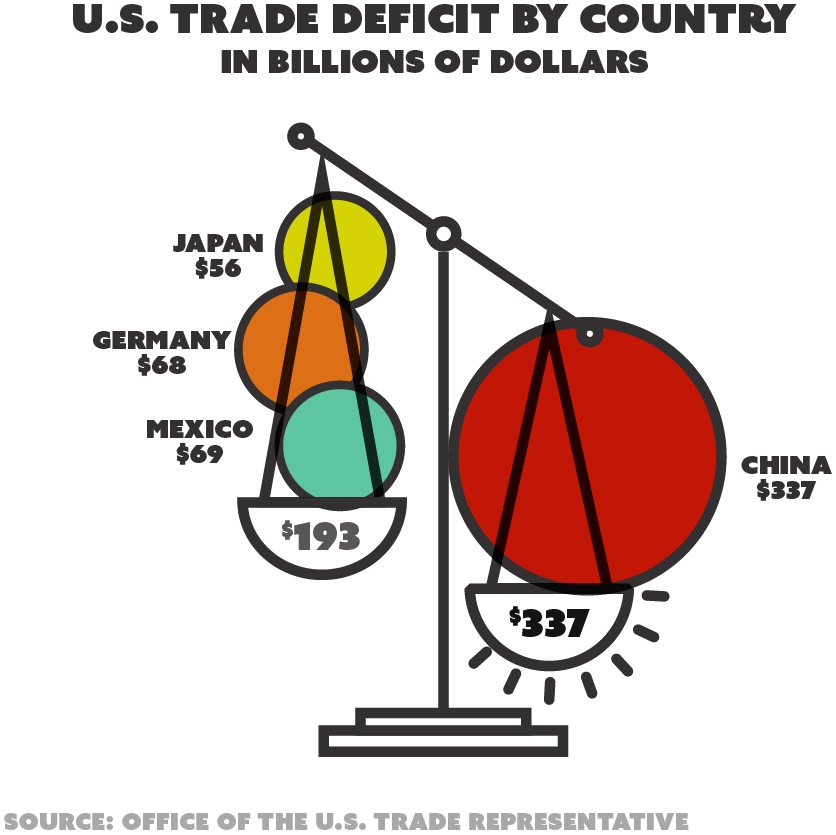
The trade war is an economic conflict between the United States and China that has major repercussions on everyday life. The future of international relations and the global economy is greatly dependent upon its outcome.
Sources:
https://www.cnbc.com/2019/03/01/the-timeline-of-trump-china-tariffs-and-trade-war.html
https://www.whitehouse.gov/briefings-statements/statement-president-donald-j-trump-additional-proposed-section-301-remedies/
http://fortune.com/2018/04/02/china-tariffs-128-us-products/
Laika: The Space Dog
Shortly after the launch of Sputnik, the US public was stunned by another Soviet launch less than a month later. This particular satellite was sent to orbit around the earth while also containing the first living organism, a dog named Laika. While Laika's voyage showed that an organism could survive the weightlessness and the initial launch, as she apparently survived for about 4-7 days in space, it turns out that she died within a few hours.
Laika started as a stray on the streets of Moscow before she began he path to fame. She was chosen as a stray with the belief that she would be more prepared to the cold and the little amount of food that she would receive during her voyage. To prepare her, they would send her up in high altitude rockets and confine her to extremely small spaces in order to simulate her journey.
Finally, on November 3rd, 1957, she was launched into space on the Sputnik 2 becoming the first living organism to orbit the planet. This shocked the world but also caused outrage when the public realized that there was no plan to get her down from orbit as that technology hadn't been invented yet. Furthermore, she had to endure terrifying conditions throughout her short-lived flight such as being chained forward and confined to a tiny space.
Soviet engineers and scientists had designed the satellite to try and keep Laika alive as long as possible by using a fan to regulate temperatures, feeding her food, circulating oxygen, and providing a system of waste disposal for her. Despite these measures, most scientists agreed that she would be dead within a week.
The Soviet Union officially reported that she had died on day six due to either an oxygen shortage or a controlled euthanization using food poisoning over time, but these accounts varied for the next 4 decades. Finally, in 2002, a scientist who worked on the mission revealed that she had died within her 4th orbit or less than 5 hours. The stress of being launched shot her heart rate up 3 to 4 fold and she never truly recovered from that. But her main cause of death is considered to be overheating as part of the rocket did not properly separate, affecting the temperature control.
Nowadays, there are multiple monuments to her and her contributions to space travel in Russia and she remains an important part of space history today.
https://www.smithsonianmag.com/smithsonian-institution/sad-story-laika-space-dog-and-her-one-way-trip-orbit-1-180968728/
https://www.space.com/38660-laika-space-dog-launch-60th-anniversary.html
Historical References in Forrest Gump
Many of us have seen or at least heard of the movie Forrest Gump. If you haven't, it is about a man, named Forrest Gump, that has a below average IQ, growing up in the fictional town of Greenbow Alabama. Being born in 1944, he lives through much of the Cold War, Civil Rights Movement, and many other historical events we have studied this year.
First, a man named Elvis Presley goes to stay at Forrest's childhood house for a few days and his mom finds him in a room with Elvis, dancing to the guitar. A later in the movie, he sees Elvis on TV doing the same dance Forrest did at his house. Elvis Presley was a very influential singer in the genre of Rock n' Roll which captivated young audiences for his radical style during the 1950s. He introduced many common topics in this genre like sex and drugs.
Forrest's mother mentions that she named him after the Civil war hero, Nathan Bedford Forrest who founded the Klu Klux Klan during the 1800's. The movie shows a clip from the controversial film The Birth of a Nation with Tom Hanks' face in place of Nathan Bedford Forrest in the movie. This movie was an extremely racist film and showed some of the worst stereotypes of African Americans in the US. However, this movie was popular when it was released which reflects the country's racist views on African Americans.

One major event seen in the movie is the Vietnam War, when Forrest enlists in the army. After graduating from college, making the All American Football team and meeting president Kennedy, Forrest goes through training and flies out to Vietnam. In this part of the movie you can see the Guerrilla Warfare tactics used by the Viet kong against the American soldiers, when Lieutenant Dan warns forrest about snipers everywhere but you can never see them. The Vietnam War was supported at first but after the war went on, people wanted to be finished with it. There were too many casualties and the people felt it wasn't worth it. When Nixon became president, he instated a policy of Vietnamization which eventually lead to the end of the war.
After being injured in battle, Forrest returns to the US injured with an gunshot to his butt. In the hospital, Forrest learns of ping pong and instantly becomes interested in the sport. He eventually gets so good at it that he was sent to China in Ping Pong Diplomacy in hopes of reducing tension between China and the US during the Cold War.

Other parts of the movie reference hippies, the Black Panther Party, and John Lennon. Jenny Curran, a childhood friend of forrest, is supposed to be a hippie in this movie. They were people that advocated for peace in the world, along with experimenting with lots of drugs, as seen in the movie. Forrest and Jenny end up going to a Black Panther meeting, where one of the leaders explains to Forrest that they are opposed to the war in Vietnam because black soldiers were giving their lives to a country that wasn't treating them very well. Forrest wasn't listening to him very much though.

Some of my favorite parts of the movie are just of Forrest being in the wrong place at the wrong time. Governor Wallace was the racist governor of Alabama at the time and in 1963 refused to let two black students in at the University of Alabama. In the movie, Forrest is seen in the background just looking around. The Watergate scandal is also seen in this movie when Forrest stayed at a hotel right next to the Watergate and sees the break in happen before his eyes. However, Forrest doesn't see this as a break in and tells security that the people must be lost and the power must have been out. It's assumed that this was how the burglars were caught.


Source:
http://forestgumpapush.weebly.com/historical-references-in-the-movie.html
First, a man named Elvis Presley goes to stay at Forrest's childhood house for a few days and his mom finds him in a room with Elvis, dancing to the guitar. A later in the movie, he sees Elvis on TV doing the same dance Forrest did at his house. Elvis Presley was a very influential singer in the genre of Rock n' Roll which captivated young audiences for his radical style during the 1950s. He introduced many common topics in this genre like sex and drugs.
Forrest's mother mentions that she named him after the Civil war hero, Nathan Bedford Forrest who founded the Klu Klux Klan during the 1800's. The movie shows a clip from the controversial film The Birth of a Nation with Tom Hanks' face in place of Nathan Bedford Forrest in the movie. This movie was an extremely racist film and showed some of the worst stereotypes of African Americans in the US. However, this movie was popular when it was released which reflects the country's racist views on African Americans.
One major event seen in the movie is the Vietnam War, when Forrest enlists in the army. After graduating from college, making the All American Football team and meeting president Kennedy, Forrest goes through training and flies out to Vietnam. In this part of the movie you can see the Guerrilla Warfare tactics used by the Viet kong against the American soldiers, when Lieutenant Dan warns forrest about snipers everywhere but you can never see them. The Vietnam War was supported at first but after the war went on, people wanted to be finished with it. There were too many casualties and the people felt it wasn't worth it. When Nixon became president, he instated a policy of Vietnamization which eventually lead to the end of the war.
After being injured in battle, Forrest returns to the US injured with an gunshot to his butt. In the hospital, Forrest learns of ping pong and instantly becomes interested in the sport. He eventually gets so good at it that he was sent to China in Ping Pong Diplomacy in hopes of reducing tension between China and the US during the Cold War.
Other parts of the movie reference hippies, the Black Panther Party, and John Lennon. Jenny Curran, a childhood friend of forrest, is supposed to be a hippie in this movie. They were people that advocated for peace in the world, along with experimenting with lots of drugs, as seen in the movie. Forrest and Jenny end up going to a Black Panther meeting, where one of the leaders explains to Forrest that they are opposed to the war in Vietnam because black soldiers were giving their lives to a country that wasn't treating them very well. Forrest wasn't listening to him very much though.
Some of my favorite parts of the movie are just of Forrest being in the wrong place at the wrong time. Governor Wallace was the racist governor of Alabama at the time and in 1963 refused to let two black students in at the University of Alabama. In the movie, Forrest is seen in the background just looking around. The Watergate scandal is also seen in this movie when Forrest stayed at a hotel right next to the Watergate and sees the break in happen before his eyes. However, Forrest doesn't see this as a break in and tells security that the people must be lost and the power must have been out. It's assumed that this was how the burglars were caught.
Source:
http://forestgumpapush.weebly.com/historical-references-in-the-movie.html
the eras of hollywood
Recently I've begun to watch a lot of TV and it got me to start to think about the movie industry and how influential Hollywood really is. It's been the center of the McCarthy witch hunt, been a crucial role in the US propaganda machine, central to 20th-century American culture, and even given us one of our own Presidents, Ronald Reagan. In Hollywood, there have been a few major eras that define the films and studios that create them.
Before the Golden Era of Hollywood Film was developed as a tool to examine objects in motion but ultimately perfected by Edison's laboratories. In order to create films which had largely been monopolized by the Edison film conglomerate, Motion Picture Patents Company, many moved out west to a small unnotable town just outside of LA called Hollywood. Despite the breaking up of Motion Picture Patents Company by an Anti-Trust, the film industry had firmly put down roots in California.
Before the advent of color film and even the ability to record sound there was the silent film era. During this era, the big eight had emerged as the notable studios, some of which are still around today like Metro-Goldwyn-Mayer, Universal Pictures, and Columbia Pictures. They created plenty of meaningful and artistic works of the film but also demonstrated the negative influences that film could have with their film, "The Birth of a Nation" it's a racist depiction of African Americans and the glorification of slavery was a major factor in the resurgence of the Ku Klux Klan in the 1920s.
The development of audio led to a rise of "the talkies" which gave rise to the golden era of Hollywood which saw the dominance of the studio system which held unprecedented power over almost every aspect of the film industry from contracting with actors to filming, and editing, to screening and owning theaters. Studios became so influential that they often created stars based on their own clout and their ability to control every aspect of the industry allowed them to give them a spot equivalent to a long time movie star. During this time the American film industry exploded and truly became a major part of American culture. As the industry became famous for creating the next wave of mass media and soon after was conscripted into creating war propaganda for the US during world war two. It was a period of extravagance and power as the industries wielded their massive power in order to make films for the masses.
However, the good times could not last forever and the golden era died due to a barrage of antitrust lawsuits, concerns of the morality of the industry, and the suspected communist sympathizers within the industry. Despite these setbacks that limited the studio system Hollywood still created some incredibly notable cinema during this time period including films such as, Some like it Hot and Ben-Hur.
The collapse of the old industry allowed for the rise of a newer and youth dominated industry. The 60s counterculture movement had reached Hollywood and with films like Bonnie and Clyde including darker and more overtly sexual undertones, the concerns over morality seemed to be a thing of the past. This new Hollywood saw the rise of directors like Steven Spielberg and is considered to be a Renaissance of the film industry "rediscovering" the classics of the 20s 30s and 40s. This new era also embraced a far less glitzy and more realistic portrayal of life which resonated more with the average American. Perhaps the most famous movie ever "The Godfather" was produced and was a staple of this era in film history.
However, this edgy era of film history did not last forever and the resurgence of powerful studios along with a return to a classical glitzy type of film ushered in the current age of blockbuster films. The transition between these periods can be seen in Movies such as the original Star Wars trilogy which demonstrated the blockbuster Hollywood glitz but still had a darker and edgier undertone. Compare the original trilogy to the current trilogy and the difference between the Counterculture Hollywood and Blockbuster Hollywood becomes even more evident. Strong studios, the motivation of profit, and the rise of DVDs and then streaming has fundamentally changed the film industry back into its more classical self. But the rise of streaming and technology has also lead to the rise of many new alternative genres. It's hard to say where the industry will go from here but it's clear that Hollywood will remain an important staple of American culture.
https://tvtropes.org/pmwiki/pmwiki.php/Main/HistoryOfHollywood
Subscribe to:
Posts (Atom)